

What Happens When Markets Stop Caring About Price?
By Chaya Slain, Virtera Partners President and Chief Investment Officer.
For decades, the Efficient Market Hypothesis gave investors a clean story: markets are efficient, prices reflect fundamentals and capital flows to the best opportunities. That story has always had skeptics but a growing body of research is making it harder to defend.
A recent Financial Times interview with hedge fund manager and physicist Jean-Philippe Bouchaud discussed the “Inelastic Markets Hypothesis,” which argues that market prices may be driven more by flows than fundamentals. In Bouchaud’s opinion, “the whole bull run is because of an influx of money into the market.”
The structural reality is that we are now living through one of the largest mechanical flow events in financial history driven by the rise of passive investing. Trillions of dollars are flowing into index funds that buy securities based on rules, not valuation. The money does not ask whether a company is overvalued, whether growth assumptions are realistic, or whether insiders are selling at the perfect time. The index simply buys. More than 50% of capital is now in passive strategies [1].
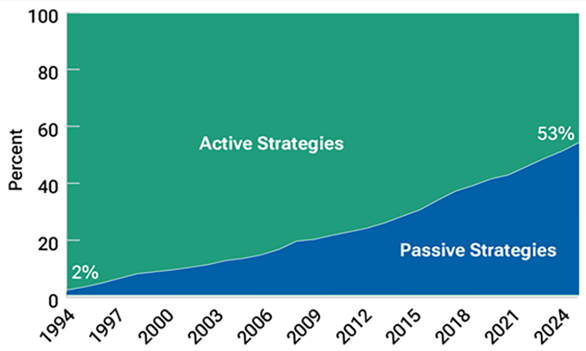
Chart shows the percentage of U.S. mutual fund and ETF share of market in active and passive strategies as of December 31, 2024. Source: Morningstar and T. Rowe Price.
And the flows continue almost automatically. Millions of Americans contribute to retirement accounts every two weeks and those dollars are systematically directed into index funds that buy the underlying securities regardless of valuation.
At the same time, venture capital has changed dramatically. The largest venture firms now control enormous pools of capital. They can fund companies privately for far longer, push valuations to extraordinary levels, and eventually bring those companies public at massive scale.
SpaceX, OpenAI, and Anthropic are each preparing to go public this year at combined valuations approaching $4 trillion. These are extraordinary companies building extraordinary things. But extraordinary companies and extraordinary investments are not the same thing and price always matters. Except, it turns out, to index funds.
Index funds are rules-based, price-agnostic buyers. Once a company enters the index, roughly $24 trillion in passive capital is effectively obligated to own it.
The venture firms and late-stage investors backing these companies need liquidity. Public markets provide that liquidity, but only if there is sufficient demand at the valuations they hope to achieve. The enormous pool of passive capital sitting inside index funds offers a natural buyer base. The challenge was getting these companies into the indexes quickly enough for that demand to matter.
That obstacle is now being removed as the system itself appears willing to accommodate it. The Wall Street Journal recently reported that Nasdaq implemented a new Fast Entry rule in May of this year, allowing mega-cap IPOs to join the Nasdaq-100 after just 15 trading days. S&P Dow Jones Indices is considering cutting its own waiting period from 12 months to 6 and waiving the profitability requirement entirely for companies above $200 billion in market cap. Neither OpenAI nor Anthropic is GAAP profitable. The rules, as they existed, were a problem so the rules are being changed.
In other words, if a company is large enough, the index may effectively guarantee future buying pressure from passive funds regardless of valuation.
The public market increasingly risks becoming less about price discovery and more about providing liquidity for early insiders. This creates a powerful feedback loop. Large private companies grow larger because capital is concentrated in the biggest venture firms, which are often invested together in the same companies. Once public, index inclusion creates automatic demand from passive investors. That demand can then reinforce the valuation that justified the IPO in the first place.
This dynamic also raises uncomfortable questions about incentives. S&P’s credibility was challenged during the mortgage crisis when its ratings arm assigned AAA ratings to securities that later proved far riskier than advertised. Like every institution, index providers are not immune from commercial pressures.
So What Does This Mean for Your Portfolio?
Passive investing has provided enormous benefits: low fees, broad diversification, and tax efficiency. However, when flows become more important than price sensitivity, investors should at least ask whether markets are still functioning the way traditional financial theory assumes they do.
The first thing to recognize is that flows can drive prices for a long time. Passive capital is large, growing, and price-insensitive. Valuations that look stretched by traditional measures can stay stretched, or become even more stretched, as long as the inflows continue. Dismissing that dynamic does not protect investors from it.
But regimes do change. The same mechanism that drove prices up, mandatory buying driven by rules, can work just as powerfully in reverse when flows turn. The crowding and concentration that passive indexing creates on the way up can become a source of sharper and faster drawdowns on the way down.
The practical implication is that portfolios need to be built to survive multiple outcomes, not optimized for one narrative continuing forever. The goal is not to avoid participating in the party. The goal is to participate while also being prepared for when it ends, without needing to predict exactly when that will happen.
A few things follow from that.
Active management can become more valuable at the extremes. Price-insensitive capital can create larger and longer-lasting mispricings. That is precisely where disciplined active managers, particularly outside the crowded mega-cap universe, may find opportunities that passive vehicles cannot.
Flows work in both directions. Inflows helped create the move up, and outflows can create a move down that is faster and more severe than most investors expect. The exit door is always smaller than the entrance.
Prices can drift far from fundamentals. Public markets used to serve as a form of price discovery where broad investor demand helped validate a company’s valuation. But when trillions of dollars in passive capital are programmed to buy companies simply because they enter an index, that process becomes less meaningful. A company can be exceptional and still be priced far too aggressively. In this environment, investors need to pay closer attention to valuation, incentives, and who is ultimately benefiting from the transaction.
Past performance does not guarantee future results. Every cycle eventually creates its own excesses. Many investors have understandably started to question whether diversification even matters anymore. Why not simply own the S&P 500? For a long time, that has been the right answer. But investors should be careful about assuming the dominant trend of one era will persist indefinitely [2].
Diversification matters more, not less. When market leadership is increasingly driven by flows into the largest names, investors are often more exposed to concentration than they realize. A portfolio that appears diversified across hundreds of companies may functionally be a large bet on a small number of stocks.
We still believe public equities deserve an important role in portfolios. But we also believe investors need exposure to strategies and asset classes that are driven by different underlying forces. Private equity, trend following, and natural resources may all play an important role in a world where passive flows increasingly dominate traditional markets.
The challenge for investors today is not predicting exactly when this regime changes. The challenge is building portfolios resilient enough to withstand it when it does.
[1] Passive strategies are those that invest in index funds while active strategies are driven by stock pickers making independently buy and sell decisions.
[2] A historical reminder: investors have seen versions of this movie before. In the late 1960s and early 1970s, the “Nifty Fifty” became viewed as a group of one-decision stocks. These were dominant, high-quality companies that investors believed could be purchased at any price and held forever. Many of those businesses ultimately proved to be excellent companies, but the valuations investors paid still mattered. When the regime changed, many of the stocks declined dramatically despite the underlying businesses remaining strong.