

Fishing Where the Fish Are
Fishing Where the Fish Are
By Steven Francomacaro, CFA - Managing Director of Investments at Virtera Partners.
Warren Buffett’s punchy partner in crime, Charlie Munger, often explained to investors that they should "fish where the fish are." The saying is a useful description of how we approach private markets. Clients often ask us, around the launch of Virtera Private Select II, how, where, and why we invest the way we do. Our answer is this: we spend the overwhelming majority of our time in buyout, and within buyout, at the lower end of the middle market. That is where we believe the pond is still stocked.
This piece is meant to explain that answer, not to forecast which manager, sector, or sub-strategy will excite us next month or next year. Those specifics are fleeting in markets that are constantly changing, a process only accelerating as information moves faster, aided by AI. Our conviction is in the structure of where we fish, not in any single name within it.
We did not arrive at lower-middle-market buyout because of any particular magic in the buyout structure. We arrived there because three things combine more favorably here than anywhere else we've studied across private markets: the underlying company characteristics, how capital is deployed and monitored, and how capital ultimately returns to LPs. The rest of this piece walks through each in turn.
Company characteristics: why the lower middle market
Private equity at large has become a highly competitive asset class, and we don't think all private equity is created equal. Our focus is the lower end of the middle market. This includes independent sponsors ahead of a Fund I launch, or early Fund I through III managers typically running $50M-$500M in fund size. We do not have any special allegiance to a specific vintage or AUM figure. What we care about is whether a manager is genuinely built for small businesses, which most private equity firms claim to be. In our underwriting experience, few are once you look closely at co-investment structure, ownership percentages, and whether "smaller deals" are really larger deals wearing a lower-ownership stake.
It's a familiar story: a blue-chip, middle-market GP decides to "go back to basics" and raises a smaller fund, but the deal sourcing, the playbook, and the type of firm they're building all still resemble the shop they came from, rather than a firm rebuilt for the lower middle market. We spend significant diligence time distinguishing the managers who have adapted their approach from the ones who have only adapted their fund size.
The businesses themselves are usually concentrated around one or two key people, with operations, finance, and HR functions that are thin or nonexistent. Getting them investment-ready takes hands-on operational work, not just capital. That work means building out systems, installing real financial controls and developing a management bench beyond the founder. This work is also the honest explanation for why these businesses trade at lower valuations in the first place. For example, a business with two key relationships and no institutional infrastructure carries real key-person and customer-concentration risk, and buyers are going to price that in. The GP's job is to shrink that risk before the business changes hands again.
Capital deployment and monitoring
We believe private equity's typical structure, a 10 to 12 year fund life with roughly a 3 to 5 year deployment period and a 3 to 5 year harvest period, strikes the right balance between investing for the long term and staying accountable to outside capital. In our target segment, transaction sizes are modest by institutional standards, and a meaningful portion of the invested capital often goes directly onto the company's balance sheet to fund growth, rather than as a secondary payout to the seller.
That capital structure matters because of who's on the other side of the table. We caution against the reactive view that the founders sell too cheaply while private equity captures the future upside. Private equity can absolutely work that way, and clients who get pitched by sponsors and independent sponsors regularly are right to be skeptical by default. That said, in our experience, our favorite managers in this segment structure deals with meaningful founder rollover — often a substantial minority stake — and continued involvement post-close. There usually isn't a multi-generational cash-out moment in these deals. The sellers are still owners, aligned with growing the business alongside the sponsor. Our job as an allocator is to find the managers doing it that way, not the ones doing it the other way.
How capital returns to LPs
Professionalizing a business, or building a platform by combining two or three similarly sized companies under one elevated management team, is genuinely hard to execute well. Poor M&A integration, abrupt changes to long-standing customer relationships, systems slowdowns, and unplanned management turnover are the recurring ways this work goes wrong.
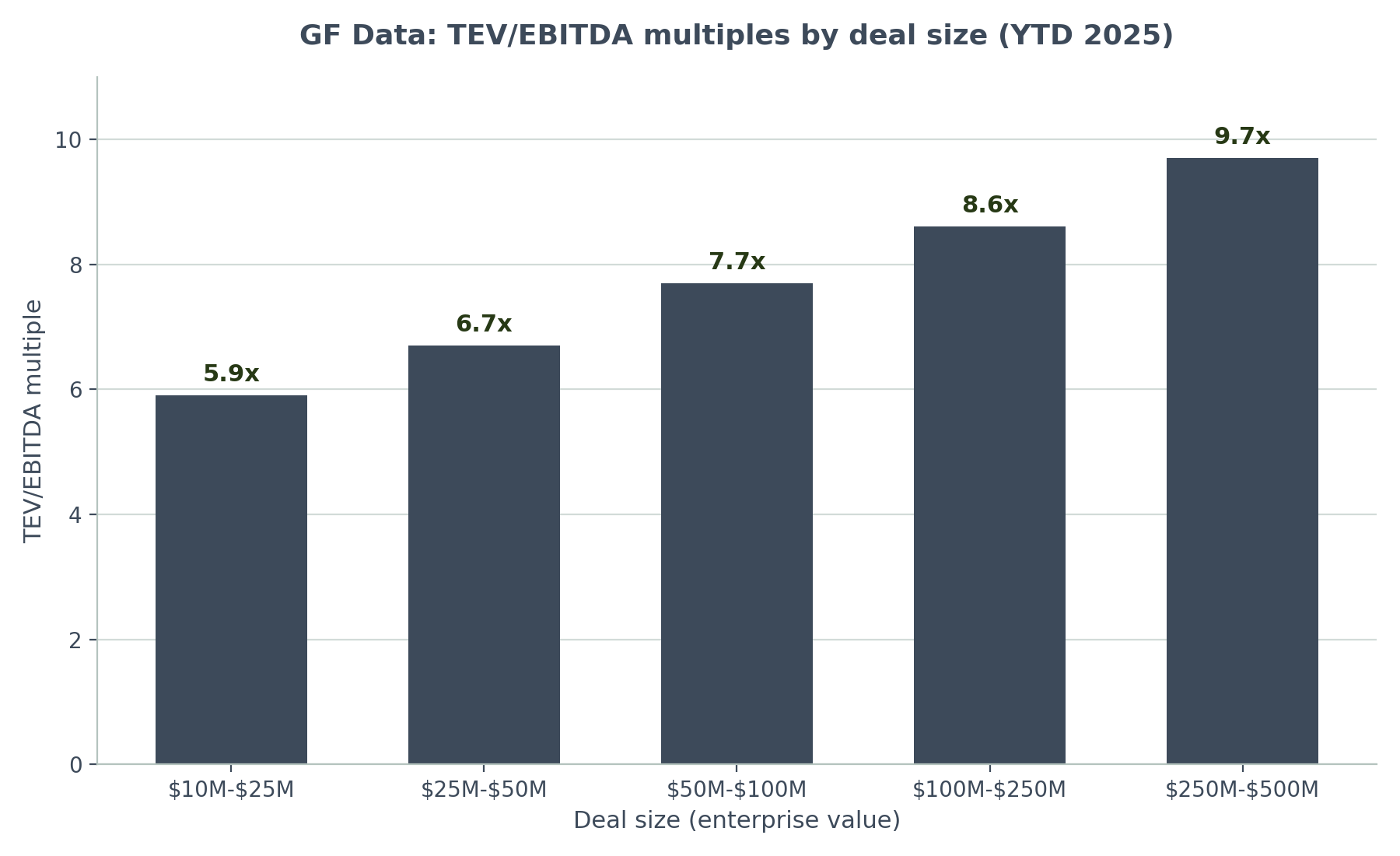
When it goes right, the market tends to pay for it. GF Data's year-to-date 2025 figures show a clear, size-based step-up in valuation. Transactions of $10M to $25M enterprise-value averaged 5.9x TTM EBITDA, rising to 7.7x at $50M to $100M and 9.7x at $250M-$500M.(1)
The investment banking infrastructure improves alongside it. Boutique bankers tend to cover the businesses below ~$10M EBITDA, while more institutional names like Harris Williams, William Blair, and Lincoln International generally lead the process above that figure. Getting a company through that threshold is, in large part, the return.
Three things temper this view. First, we believe dispersion between top and bottom quartile managers is wider in the lower middle market than in large buyout.(2) Being wrong about a manager costs more here, not just more often. Manager selection carries more weight in this segment than in any other we allocate to.
Second, the valuation step-up also depends on the gap persisting. If capital continues moving down market, the spread between 5.9x and 9.7x compresses, and the professionalization premium shrinks for everyone regardless of how well a manager executes.
Finally, the data above covers completed transactions. It does not show the businesses that got professionalized and still did not clear the threshold, or that never sold at all. Any dataset built on closed deals reflects the deals that worked.
Creating value on paper, however, is only part of the equation. The manager must also be able and incentivized to realize it. While strong assets often produce distributions within three to seven years, weaker investments can linger beyond a fund’s intended life, sometimes leaving managers with more incentive to continue collecting fees than to wind down the vehicle. Virtera therefore evaluates fund structure, time horizon, and liquidity incentives nearly as closely as the underlying manager and strategy.
Back to the pond
Virtera gets most excited about managers who play this ecosystem not as some sort of game or machine to be worked. Instead, they understand deeply what buyers upstream require, and they have a strong sense of what levers they can and cannot pull with these smaller, lower-middle-market companies.
Professionalizing and building platforms are, in our view, the most defensible skills in private markets, and the lower middle market is where we intend to keep allocating client capital for as long as the pond stays stocked.
Footnotes
1 GF Data, an ACG Company, "Middle-Market M&A ESOP Advisor Special Report," Q3 2025, Chart 1 (TEV/EBITDA by deal size, YTD 2025 column).
2 J.P. Morgan Asset Management, "A Big Role for Small and Middle-Market Private Equity Investments" (2025)
Important Disclosures
This material is provided by Virtera Partners for informational purposes only and reflects the opinions of the author as of the date of publication, which are subject to change without notice. It does not constitute investment, legal, or tax advice or a recommendation with respect to any security, fund, or strategy. Nothing herein constitutes an offer to sell, or a solicitation of an offer to buy, any security, including interests in Virtera Private Select II. Any such offer will be made only pursuant to the fund’s confidential offering documents, which contain important information regarding risks, fees, and expenses, and only to investors who meet applicable eligibility requirements, including verification of accredited investor status in accordance with Rule 506(c) of Regulation D. Investments in private markets are speculative, illiquid, and involve a high degree of risk, including the possible loss of the entire amount invested. Certain information contained herein has been obtained from third-party sources believed to be reliable; however, its accuracy and completeness cannot be guaranteed and it has not been independently verified. Certain statements reflect the author’s views regarding market trends and are forward-looking in nature; actual events or results may differ materially from those views. Past performance is not indicative of future results.